

Medically Reviewed:
Dr Yoselin Gracia (GDC No: 267285) & Dr Pedro Arteche (BDS, MSc, GDC No: 82748)
Quick Summary / Key Takeaways
- The Domino Effect is Real: A small, painless cavity inside tooth enamel can quietly breach the protective layer of dentin, eventually reaching the dental pulp and causing severe toothache, infection, or structural loss.
- Early Treatment is Simple & Preserving: Catching decay at Stage 1 or 2 requires minimal intervention, such as fluoride therapy or discreet tooth-coloured composite bonding in Fulham, saving natural enamel and keeping costs low.
- Delay Leads to Complex Care: Ignoring decay often turns a routine filling into root canal treatment, full-coverage crowns, or even dental extractions followed by restorative implants.
- Preventative Care Works: Regular dental check-ups, interdental cleaning, and evidence-based fluoride regimens as recommended by UK DBOH guidelines stop cavity progression before it starts.
It often begins with something seemingly harmless: a fleeting twinge of sensitivity when sipping hot tea, a slight discomfort when eating sweet treats, or a tiny grey shadow on the surface of a back molar. Busy schedules across Fulham, Hammersmith, and West London lead many patients to postpone an appointment, assuming that if a tooth does not ache constantly, there is no urgent problem.
However, tooth decay is a silent, progressive bacterial disease. What starts as a minor breach in the outer enamel can trigger a cascading series of oral health complications—a process known in dentistry as the Dental Decay Domino Effect. Addressing untreated tooth decay in Fulham at the first subtle warning sign prevents minor issues from snowballing into complex, multi-stage dental procedures. Understanding how decay advances, why early intervention protects natural teeth, and how preventative care keeps smiles healthy for life is essential.
Direct Clinical Answer: The Dental Decay Domino Effect is the progressive breakdown of tooth structures and surrounding tissues that occurs when initial enamel mineral loss is left untreated, eventually compromising the nerve, root, neighbouring teeth, and supporting jawbone.
When oral bacteria consume sugars from food, they produce harmful organic acids. These acids dissolve the vital minerals within protective tooth enamel. If this process is not arrested through professional care and meticulous hygiene, the bacteria breach inner tooth layers, multiplying exponentially. As each structural barrier fails, the treatment required becomes increasingly complex, invasive, and costly.
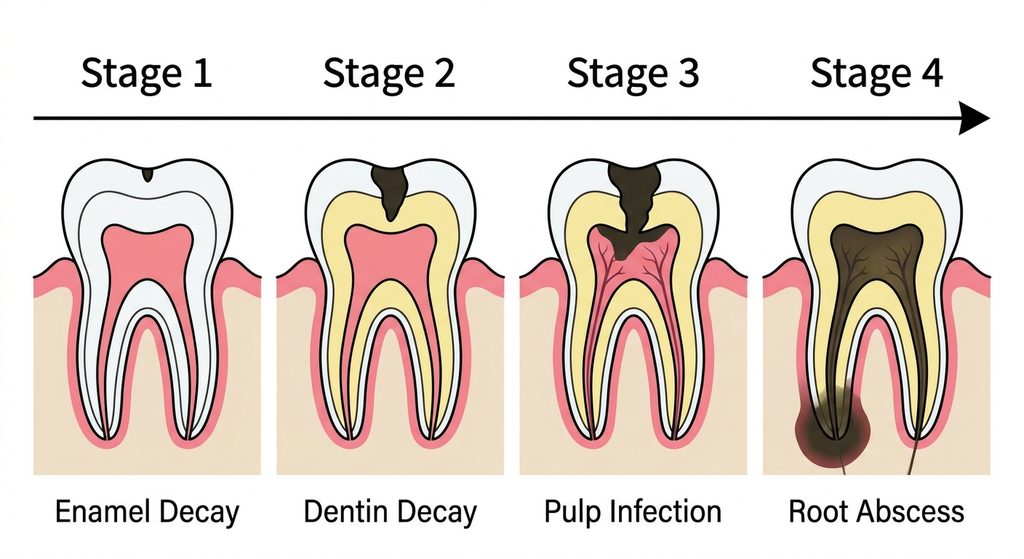
Understanding the biological progression of decay helps clarify why early detection at routine check-ups is vital. Decay advances through five distinct clinical stages:
The initial phase of decay takes place beneath the surface layer of tooth enamel. Acid attacks strip essential minerals—calcium and phosphate—from the enamel matrix. At this stage, decay is completely painless and presents visually as faint, chalky white spots on the tooth surface. Remarkably, Stage 1 decay is reversible through professional topical fluoride applications, modified diet, and improved plaque control without any drilling.
If demineralisation continues unchecked, the enamel surface breaks down, forming a permanent cavity (hole). Enamel contains no nerve fibres, so patients rarely feel pain at this stage. However, because enamel cannot naturally regenerate once broken, the physical cavity must be cleared of bacteria and restored using a durable, tooth-coloured filling to seal the tooth structure.
Once bacteria breach the enamel, they enter the dentin—the softer layer beneath enamel containing microscopic fluid-filled tubules connected to the central nerve. Decay spreads significantly faster through dentin. Patients at Stage 3 usually experience heightened sensitivity to cold, hot, or sweet foods, as well as sharp discomfort when chewing. Prompt restorative care is crucial here to prevent bacterial invasion of the nerve.
The pulp is the living heart of the tooth, packed with blood vessels and delicate nerve tissue. When bacteria invade the pulp chamber, the immune system responds with inflammation (pulpitis). Because the pulp is encased inside hard dentin walls, inflammatory swelling creates severe internal pressure. This causes intense, throbbing toothaches that often wake patients at night. At this stage, simple fillings are no longer sufficient; saving the tooth requires root canal therapy.
If pulp infection is ignored, the nerve tissue inside the root canals dies (necrosis). Bacterial toxins exit through the root tip (apex), spreading into surrounding periodontal tissues and jawbone. This results in a painful dental abscess—a localized accumulation of pus accompanied by facial swelling, fever, bad taste, and systemic inflammation. Stage 5 poses serious risks to overall health and frequently leaves tooth extraction as the only clinical option.
| Decay Stage | Primary Symptoms | Recommended Clinical Treatment | Procedure Complexity | Long-Term Prognosis |
| Stage 1: Demineralisation | None / Chalky white spots | Professional fluoride varnish & hygiene care | Non-invasive (No drilling) | Excellent (Fully reversible) |
| Stage 2: Enamel Cavity | Occasional food trapping | Direct composite tooth-coloured filling | Minimal (Single visit) | Excellent (Preserves enamel) |
| Stage 3: Dentin Decay | Sensitivity to hot, cold, sweet | Direct composite or ceramic inlay/onlay | Moderate (Single/double visit) | Good (Monitored for pulp health) |
| Stage 4: Pulp Infection | Severe, throbbing toothache | Root canal therapy & full coverage crown | Complex (Multi-step endodontics) | Fair to Good (Nerve saved/reinforced) |
| Stage 5: Abscess & Necrosis | Swelling, severe pain, loose tooth | Root canal re-treatment or extraction + implant | Highly Complex / Surgical | Guarded (Requires replacement) |
Direct Clinical Answer: Ignored cavities escalate quickly because human tooth enamel is thin, and once bacteria penetrate into the porous dentin layer, microbial proliferation accelerates rapidly towards the central vascular pulp tissue.
Several anatomical and biological factors fuel this rapid breakdown:
When untreated decay progresses to Stage 5, extracting the tooth is often necessary to eliminate persistent infection. However, losing a single tooth triggers a secondary domino effect across your entire bite and jaw structure:
Preventing tooth loss by stopping decay early preserves your natural bite alignment and avoids the need for advanced restorative options like bridge work or private dental implants in Hammersmith
When caught during Stages 2 or 3, treating decay involves gently removing compromised structure and placing a durable composite resin filling. Matchable to your precise natural tooth shade, composite restorations bond directly to enamel and dentin, reinforcing the remaining tooth without requiring extensive preparation. You can view transparent pricing details on our Alma Smiles fee guide.
When decay reaches Stage 4, saving the natural tooth requires root canal treatment. Performed by skilled clinicians—such as our general dentists with a special clinical interest in endodontics (Dr Krisztina Papp DMD, GDC No. 262776)—this procedure carefully cleans, disinfects, and seals the infected internal root canals. Following endodontic therapy, the tooth is protected with a custom ceramic crown to restore full strength and prevent future fracture.
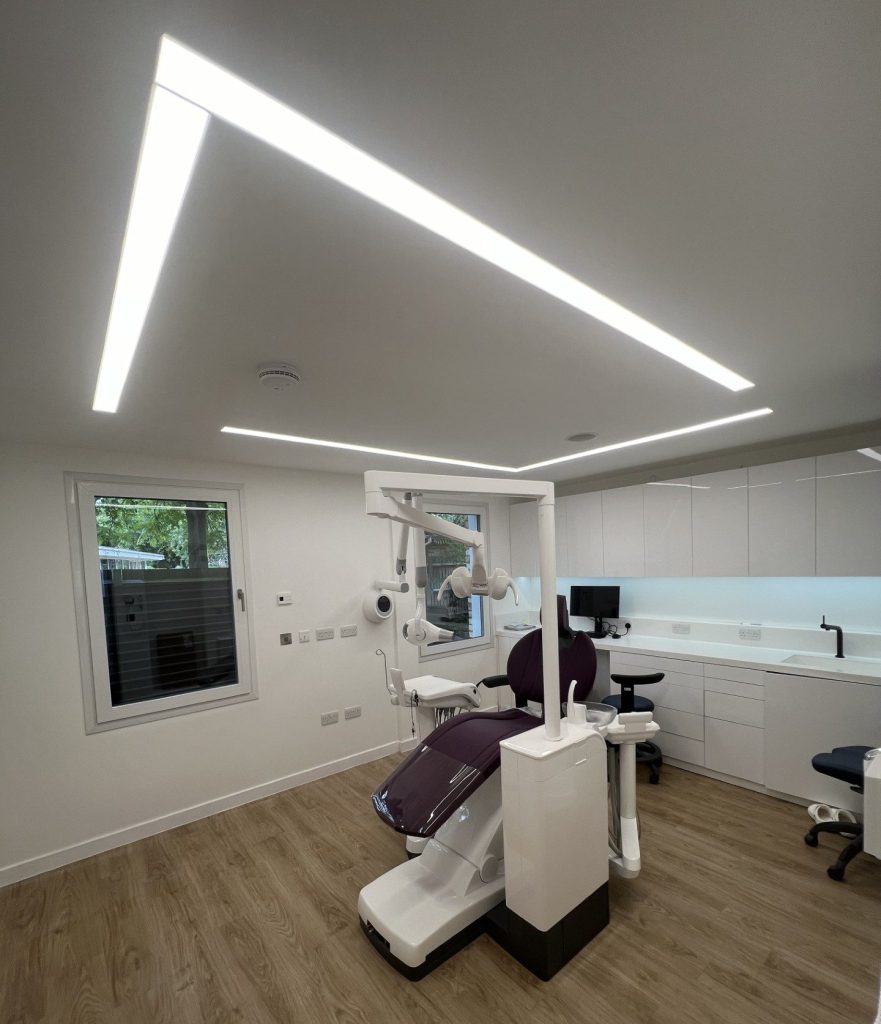
The UK Department of Health’s Delivering Better Oral Health (DBOH) toolkit provides clear, evidence-based guidelines for preventing and stopping dental decay at home and in the clinic:
At Alma Smiles Dental Clinic, we believe that proactive, comfortable dental care should be effortless and stress-free for residents across Hammersmith, Fulham, Parsons Green, Ravenscourt Park, Brackenbury Village, Barons Court, Chiswick, and West Kensington.
Located conveniently at 86 Fulham Palace Road, Hammersmith, London, W6 9PL, our welcoming practice is designed to cater to patients who feel anxious or apprehensive about dental visits. We offer a calm, judgment-free environment where every patient receives gentle, personalised care. Meet our dedicated team of professionals on our clinical team page.
Stage 1 enamel demineralisation can re-mineralise and heal through topical fluoride treatments, improved oral hygiene, and reduced sugar intake. However, once decay breaks through enamel to form a physical cavity (Stage 2 onwards), it cannot self-heal and requires professional removal and filling.
The progression rate varies based on individual saliva flow, diet, hygiene, and enamel thickness. In adults, untreated decay typically takes anywhere from 6 to 18 months to travel through enamel and dentin to reach the nerve, though progression can be faster in young patients.
No, early to moderate tooth decay rarely causes noticeable pain because enamel has no nerve endings. Sensitivity or throbbing pain usually occurs only after decay reaches deeper dentin or the central pulp tissue, which is why routine dental check-ups are vital.
Leaving a cavity untreated for years allows bacteria to destroy the tooth crown, infect the root canals, cause painful jaw abscesses, and erode surrounding bone. Ultimately, the tooth breaks down entirely, necessitating extraction and complex artificial replacement.
Modern root canal treatment is performed under effective local anaesthetics, making the procedure as comfortable as receiving a routine filling. Endodontic care is designed to relieve the intense pain caused by pulp infection, restoring comfort swiftly.
UK clinical guidelines recommend routine dental check-ups every 6 to 12 months for most adults. Patients with higher risk factors for decay may benefit from more frequent visits as advised by their dentist.
At Alma Smiles, private tooth filling costs depend on the size of the restoration and the material selected (e.g. direct composite resin). We provide full, transparent cost breakdowns prior to treatment. You can review current prices on our fee guide ([https://www.almasmiles.com/fees/](https://www.almasmiles.com/fees/)).
Don’t wait for minor sensitivity to become a dental emergency. At Alma Smiles, Dr. Yoselin Gracia (GDC No: 267285), Dr Pedro Arteche (GDC No: 82748), and our experienced dental team are dedicated to providing gentle, thorough care to preserve your natural smile. Read inspiring stories from local West London patients on our patient reviews page.
📞 Contact Alma Smiles Dental Clinic
- Call Our Reception Team: 020 8748 1315
- Email Us: hello@almasmiles.com
- Visit Us: Alma Smiles Dental Clinic, 86 Fulham Palace Road, Hammersmith, London, W6 9PL
- Book Online: Visit www.almasmiles.com



What You Will Learn in This Article Before diving into our full guide, here is a quick look at what we will cover to help…
DISCOVER MORE


Post-Summer Dental Reset Fulham | Alma Smiles What You Will Learn in This Article The Summer Effect: How iced coffee, Aperol, red wine, summer berries,…
DISCOVER MORE
Bio-Hacking Your Oral Microbiome | Alma Smiles Hammersmith Quick Navigation: What You Will Learn in This Guide The Science of the Oral Microbiome: Understanding the…
DISCOVER MORE

Back-to-School Children's Dentistry Fulham | Alma Smiles What You Will Learn in This Article The Back-to-School Boost: Why late summer is the perfect moment for…
DISCOVER MORE
Fissure Sealants & Fluoride | Alma Smiles Hammersmith Quick Navigation: What You Will Learn in This Guide UK Child Oral Health Statistics: Key national figures…
DISCOVER MORE
What is the Link Between Gum Disease and Heart Health? Quick Navigation: What You Will Learn in This Guide UK Gum Disease Statistics: Key national…
DISCOVER MORE

Invisalign Teen vs Braces: Best Age & Choice | Alma Smiles The teenage years are a formative time defined by self-discovery, academic milestones, and growing…
DISCOVER MORE

Modern Guide to Composite Bonding For many of us, the mere sound of a dental drill can trigger a wave of anxiety. If you have…
DISCOVER MORE

In West London, your wedding day is one of the most photographed milestones of your adult life. Whether you are hosting an elegant reception at…
DISCOVER MORE
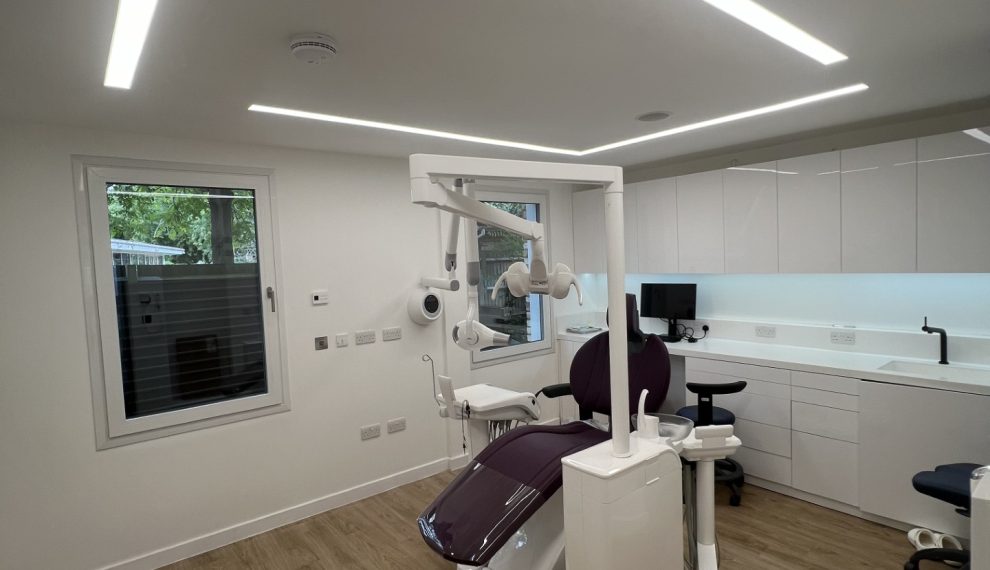
Emergency Dentist Hammersmith: Broken Tooth Care | Alma Smiles In West London, a confident, intact smile is a key part of your personal brand. Whether…
DISCOVER MORE

Little Smiles: A Parent’s Guide to Your Child’s First Dental Visit in Hammersmith and Fulham In the heart of West London, we understand that a…
DISCOVER MORE
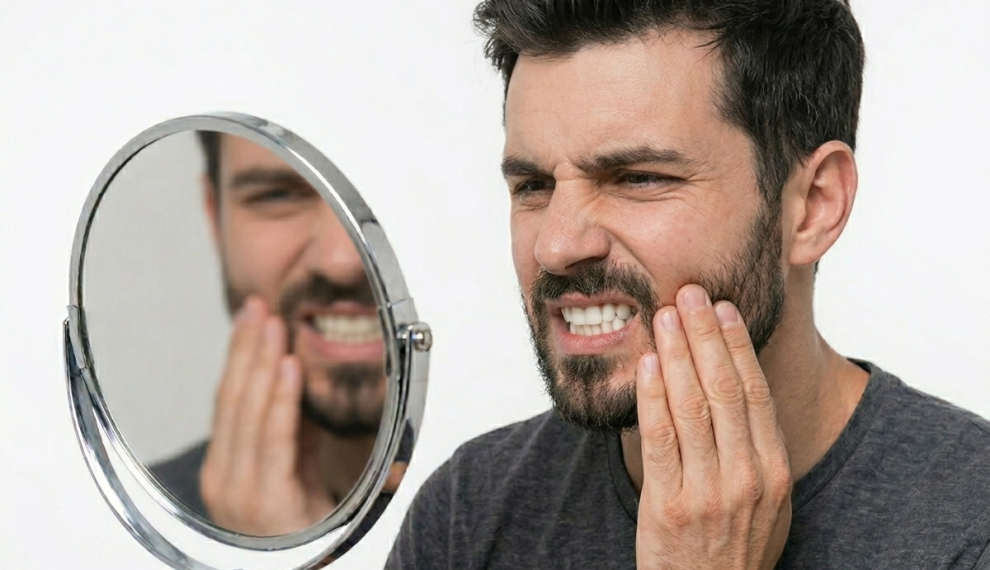
Teeth Whitening: DIY Kits vs Whitening Gold Standards In West London, a confident smile is part of your personal brand. Whether you are heading to…
DISCOVER MORE

The Lifelong Guide: Dental Care at Every Stage Why Your Smile Needs a Decade-Specific Roadmap In our fast-paced corner of West London, we often plan…
DISCOVER MORE
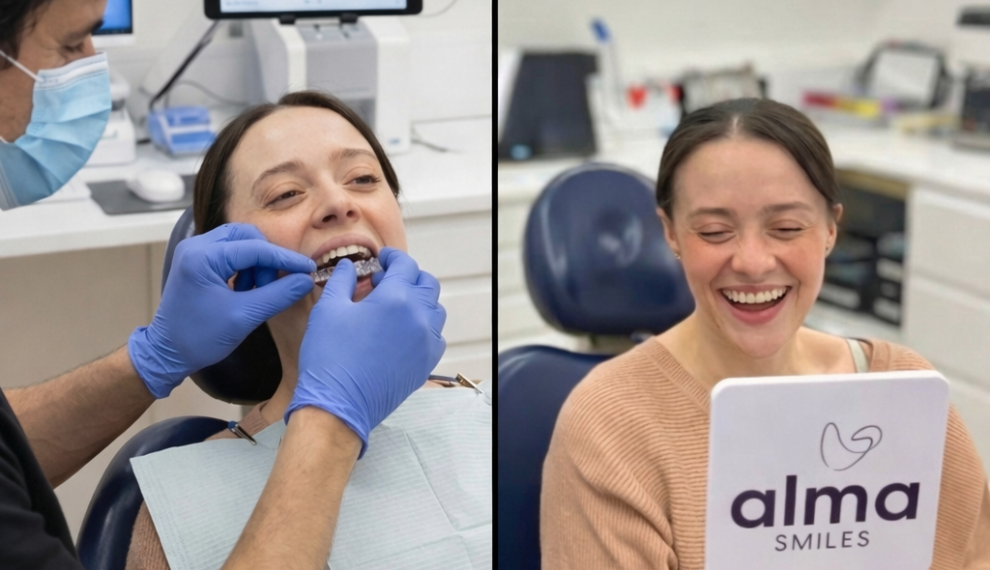
Invisalign in Fulham: Why Professional Care Beats Mail-Order Kits In an era of doorstep deliveries, the appeal of "DIY" dental kits has grown. You’ve…
DISCOVER MORE
Busy in W6 & SW6? Your Friendly Guide to Stress-Free Lunch-Break Dentistry Let’s be honest, life in West London is a whirlwind. Whether you…
DISCOVER MORE
Precision & Transparency In 2026, the gap between public and private dental care has widened due to new NHS contract reforms. While the NHS focuses…
DISCOVER MORE
What to Do When Implants Fail? Dental implants are widely regarded as the gold standard for replacing missing teeth. When carefully planned, placed, and maintained,…
DISCOVER MORE
What You Will Learn in This Article Before diving into our full guide, here is a quick look at what we will cover to help…
DISCOVER MORE
Post-Summer Dental Reset Fulham | Alma Smiles What You Will Learn in This Article The Summer Effect: How iced coffee, Aperol, red wine, summer berries,…
DISCOVER MORE
Bio-Hacking Your Oral Microbiome | Alma Smiles Hammersmith Quick Navigation: What You Will Learn in This Guide The Science of the Oral Microbiome: Understanding the…
DISCOVER MORE
Back-to-School Children's Dentistry Fulham | Alma Smiles What You Will Learn in This Article The Back-to-School Boost: Why late summer is the perfect moment for…
DISCOVER MORE
Fissure Sealants & Fluoride | Alma Smiles Hammersmith Quick Navigation: What You Will Learn in This Guide UK Child Oral Health Statistics: Key national figures…
DISCOVER MORE
What is the Link Between Gum Disease and Heart Health? Quick Navigation: What You Will Learn in This Guide UK Gum Disease Statistics: Key national…
DISCOVER MORE
Invisalign Teen vs Braces: Best Age & Choice | Alma Smiles The teenage years are a formative time defined by self-discovery, academic milestones, and growing…
DISCOVER MORE
Modern Guide to Composite Bonding For many of us, the mere sound of a dental drill can trigger a wave of anxiety. If you have…
DISCOVER MORE
In West London, your wedding day is one of the most photographed milestones of your adult life. Whether you are hosting an elegant reception at…
DISCOVER MORE
Emergency Dentist Hammersmith: Broken Tooth Care | Alma Smiles In West London, a confident, intact smile is a key part of your personal brand. Whether…
DISCOVER MORE
Little Smiles: A Parent’s Guide to Your Child’s First Dental Visit in Hammersmith and Fulham In the heart of West London, we understand that a…
DISCOVER MORE
Teeth Whitening: DIY Kits vs Whitening Gold Standards In West London, a confident smile is part of your personal brand. Whether you are heading to…
DISCOVER MORE
The Lifelong Guide: Dental Care at Every Stage Why Your Smile Needs a Decade-Specific Roadmap In our fast-paced corner of West London, we often plan…
DISCOVER MORE
Invisalign in Fulham: Why Professional Care Beats Mail-Order Kits In an era of doorstep deliveries, the appeal of "DIY" dental kits has grown. You’ve…
DISCOVER MORE
Busy in W6 & SW6? Your Friendly Guide to Stress-Free Lunch-Break Dentistry Let’s be honest, life in West London is a whirlwind. Whether you…
DISCOVER MORE
Precision & Transparency In 2026, the gap between public and private dental care has widened due to new NHS contract reforms. While the NHS focuses…
DISCOVER MORE
What to Do When Implants Fail? Dental implants are widely regarded as the gold standard for replacing missing teeth. When carefully planned, placed, and maintained,…
DISCOVER MORE

“They have a very nice and friendly staff. The place is modern and clean. I went for a check-up, and the doctor explained everything I…”

“My sincere thanks to Dr Pedro Arteche, who did a wonderful job. When he started working with my teeth, I immediately felt his professionalism. He…”
“Lovely people, and the staff have helped me tremendously. Any questions I have are always answered with great detail, and they're calming and reassuring when…”
“I had a great experience at Alma Smiles with their highly professional staff a very friendly environment. I highly recommend this place. It is clean,…”
“Welcoming staff and pleasant experience. I have been coming to Alma Smiles for years now, and I find it convenient and positive. My teeth have…”
“I would highly recommend Alma Smiles. I had an excellent experience since day one. I have had my orthodontic treatment and am very happy with…”
“I have always found all staff very polite, helpful and very professional. They are very good at giving me the best advice and encouragement and…”
“Great staff, kind and professional. The architecture of the building is very cosy and comfortable. I booked my appointment within minutes, and it took minutes.…”
“Incredible! The best dentist I’ve been to. The staff were so friendly, and the manager was so welcoming and really reassured me when I kept…”
“Doctor Krisztina, Jessie, Alex, Ayah and Joe have all been fantastic, very friendly and patient. While having my root canal, I could not have felt…”
“Alma Smiles - has been my surgery for some time now. I admit I don't like going to the dentist's, but the service provided by…”
“It was an outstanding experience from start to finish! Both my 3-year-old son and I received exceptional care. Pedro and his staff were incredibly patient…”
“I highly recommend Alma Smiles! I had a direct composite and a mouth guard after my tooth canal treatment, and I’m very happy with the…”
“My recent experience at Alma Smiles exceeded my expectations in every way. The staff was friendly and knowledgeable; the facility was modern and clean, and…”
“It is really a top surgery. I even travelled 45 minutes away to get here, even though I had local ones. It's really modern and…”
“They have a very nice and friendly staff. The place is modern and clean. I went for a check-up, and the doctor explained everything I…”
“My sincere thanks to Dr Pedro Arteche, who did a wonderful job. When he started working with my teeth, I immediately felt his professionalism. He…”
“Lovely people, and the staff have helped me tremendously. Any questions I have are always answered with great detail, and they're calming and reassuring when…”
“I had a great experience at Alma Smiles with their highly professional staff a very friendly environment. I highly recommend this place. It is clean,…”
“Welcoming staff and pleasant experience. I have been coming to Alma Smiles for years now, and I find it convenient and positive. My teeth have…”
“I would highly recommend Alma Smiles. I had an excellent experience since day one. I have had my orthodontic treatment and am very happy with…”
“I have always found all staff very polite, helpful and very professional. They are very good at giving me the best advice and encouragement and…”
“Great staff, kind and professional. The architecture of the building is very cosy and comfortable. I booked my appointment within minutes, and it took minutes.…”
“Incredible! The best dentist I’ve been to. The staff were so friendly, and the manager was so welcoming and really reassured me when I kept…”
“Doctor Krisztina, Jessie, Alex, Ayah and Joe have all been fantastic, very friendly and patient. While having my root canal, I could not have felt…”
“Alma Smiles - has been my surgery for some time now. I admit I don't like going to the dentist's, but the service provided by…”
“It was an outstanding experience from start to finish! Both my 3-year-old son and I received exceptional care. Pedro and his staff were incredibly patient…”
“I highly recommend Alma Smiles! I had a direct composite and a mouth guard after my tooth canal treatment, and I’m very happy with the…”
“My recent experience at Alma Smiles exceeded my expectations in every way. The staff was friendly and knowledgeable; the facility was modern and clean, and…”
“It is really a top surgery. I even travelled 45 minutes away to get here, even though I had local ones. It's really modern and…”