


As summer arrives across West London, families throughout Hammersmith & Fulham look forward to long sunny days, relaxed routines, and well-deserved summer holidays. However, the school break, particularly during August, often brings subtle changes to daily habits that can put growing smiles at risk.
Between ice creams in local parks, frequent summer snacks, late lie-ins, and disrupted bedtime routines, children and adults alike tend to consume far more sugar while brushing less consistently. Tooth decay remains one of the single most common reasons for hospital admissions among young children in the UK, yet it is almost entirely preventable.
This is where a “prevention first” approach becomes essential. Applying fissure sealants and professional fluoride treatments before the August holidays start provides a reliable, invisible shield over vulnerable enamel.
In this guide, we explore how preventative dental care works, why pre-holiday preparation matters, and how to keep your family’s teeth protected all year round.
Many parents are surprised to learn how widespread tooth decay is among UK children. Official public health surveys demonstrate that despite improvements in hygiene awareness, early childhood cavity rates remain high across the country.
Data published by the Office for Health Improvement and Disparities (OHID) and the Oral Health Foundation highlights the reality of paediatric oral health across England:
| Oral Health Metric | National Percentage | Clinical Context |
| 5-Year-Olds with Visual Decay | 23.7% | Nearly a quarter of children start primary school with active enamel decay. |
| Hospital Admissions for Decay | #1 Cause | Tooth extractions under general anaesthesia remain the primary reason for young children entering hospital. |
| Daily Sugar Intake | Over 2x Recommended | UK children consume more than double the maximum recommended daily limit of free sugars. |
| Missed Nightly Brushing | 38% | Over a third of children occasionally skip nighttime brushing during school holidays. |
Children’s teeth are particularly susceptible to decay due to both anatomical and behavioral factors:
Preventative dentistry aims to stop tooth decay before it ever reaches the enamel. Two of the most effective, evidence-based clinical treatments for children are fissure sealants and concentrated fluoride varnish.
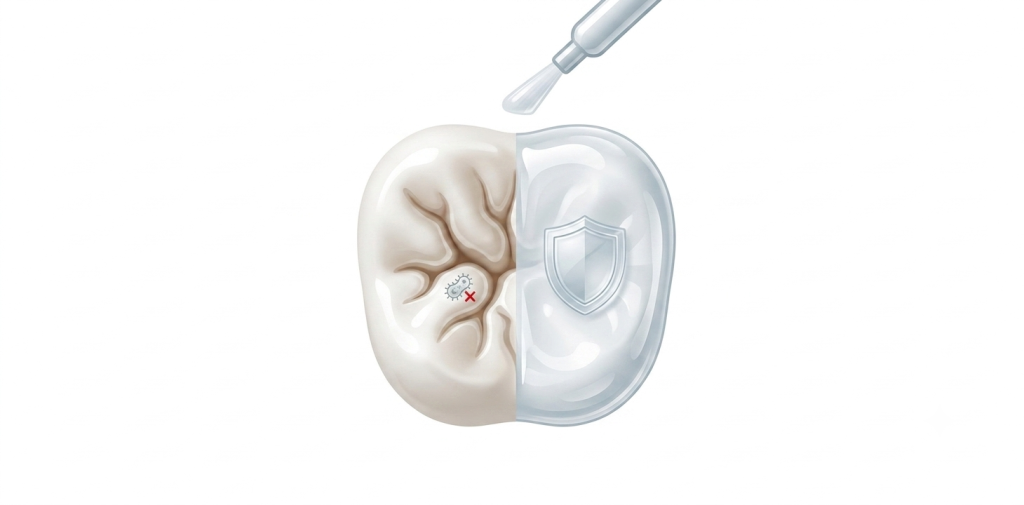
Fissure sealants are clear or tooth-coloured protective resin coatings applied directly to the chewing surfaces of permanent back teeth (molars and premolars).
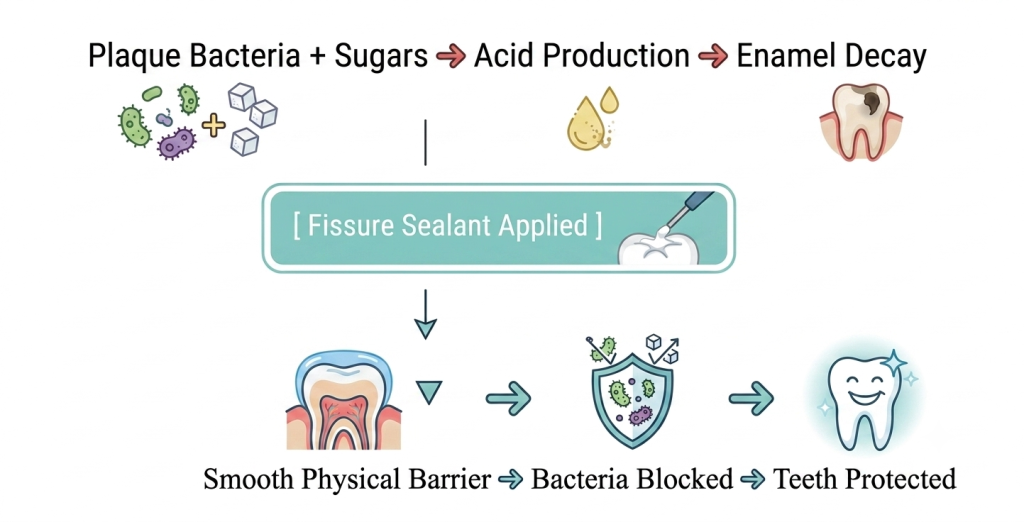
The narrow grooves on molars—known as fissures—can be finer than a single toothbrush bristle. Plaque bacteria thrive inside these sheltered crevices, feeding on dietary sugars and releasing enamel-destroying acids. Liquid fissure sealant flows into these deep grooves and hardens under a special curing light, creating a smooth, flat barrier that prevents food and bacteria from settling inside.
Fluoride varnish is a pale yellow gel or liquid containing high concentrations of fluoride. Applied quickly with a soft brush during a routine check-up, it adheres to all tooth surfaces, front, back, and between teeth.
Fluoride works by re-mineralising weakened enamel, replacing lost minerals, and making the tooth surface significantly more resistant to future acid attacks.
The month of August brings a welcome change of pace, but it also introduces several environmental factors that increase the risk of tooth decay for children and adults:
During the summer holidays, day trips, family holidays, and warm weather naturally lead to higher consumption of sugary treats. Ice creams, fizzy drinks, juices, slushies, and sticky sweets become daily occurrences rather than occasional treats. Each sugary snack triggers an acid attack on enamel that lasts approximately 20 to 30 minutes.
Without the structure of the school morning and bedtime, regular routines can slip. Late nights often mean tired children skip brushing before bed—the most critical brushing session of the day—allowing bacteria to multiply undisturbed overnight when saliva flow is naturally lower.
When staying at home or travelling, children tend to snack or graze throughout the day. Grazing deprives saliva of the time it needs to neutralize oral acids naturally, leaving enamel in a constant state of mineral loss.
Why Pre-August Protection Matters: Having fissure sealants and fluoride applied at Alma Smiles before the summer holidays begin ensures your child’s teeth have an extra, resilient layer of protection in place during this period of dietary changes and disrupted routines.
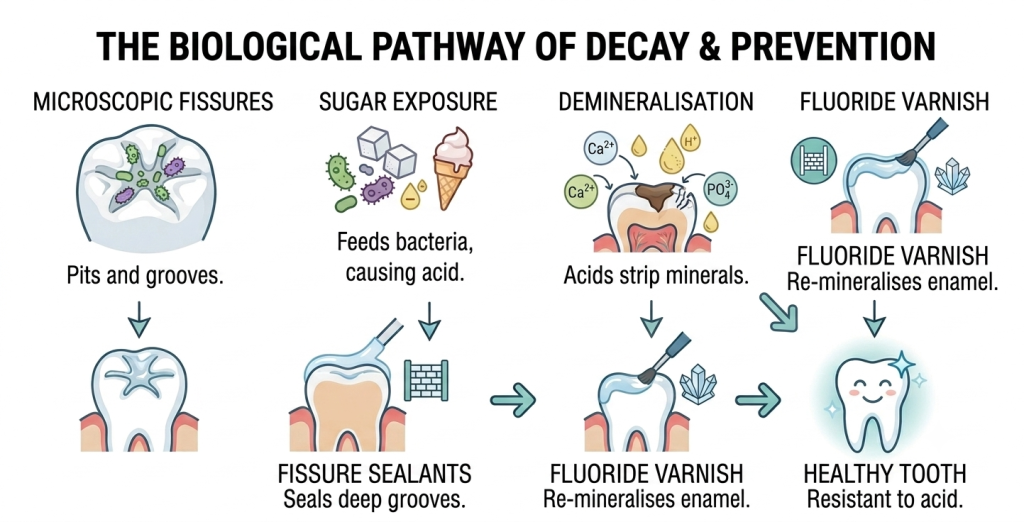
Understanding the biological process of tooth decay highlights why combined preventative treatments are so effective for young patients.
While both treatments protect against cavities, they serve complementary roles in paediatric oral healthcare:
| Feature | Fissure Sealants | Fluoride Varnish |
| Primary Protection Type | Physical barrier (seals deep grooves) | Chemical reinforcement (strengthens enamel) |
| Target Area | Chewing surfaces of adult molars/premolars | All accessible surfaces of baby and adult teeth |
| Application Process | Paint-on resin cured with a gentle blue light | Quick paint-on varnish applied with a small brush |
| Longevity | Lasts 5 to 10 years (checked at reviews) | Absorbed into enamel; reapplied 2–4 times yearly |
| Ideal Timing | Applied when first adult molars erupt (ages 6–7 & 11–13) | Recommended every 6 months from age 2 onwards |
| Discomfort Level | Completely painless; no drilling or needles | Completely painless; quick fruit-flavoured application |
Myth 1: “Baby teeth don’t need sealants or fluoride because they fall out anyway.”
Fact: Baby teeth play a critical role in speech development, proper chewing, and guiding permanent adult teeth into correct alignment. Early loss of baby teeth due to decay can lead to severe crowding and bite issues in adulthood.
Myth 2: “Fissure sealants hurt to apply.”
Fact: Applying fissure sealants is entirely painless and non-invasive. The tooth surface is gently cleaned, conditioned with a mild solution, painted with liquid sealant, and hardened with a light. There is zero drilling involved.
Myth 3: “If my child gets sealants, they don’t need to worry about summer sweets.”
Fact: Fissure sealants only protect the biting surfaces of back molars. The sides of the teeth, gumline, and front teeth remain vulnerable to decay if brushing, interdental care, and sugar moderation are neglected.
Myth 4: “Fissure sealants contain harmful chemicals.”
Fact: Dental sealants undergo rigorous safety evaluations by UK and international medical regulation authorities. They are completely safe, bio-compatible, and endorsed by major health organisations including the NHS and the British Dental Association.
To maintain your family’s oral health during the summer break, adopt this straightforward daily routine at home:
You should arrange a professional dental examination if you notice any of the following warning signs:
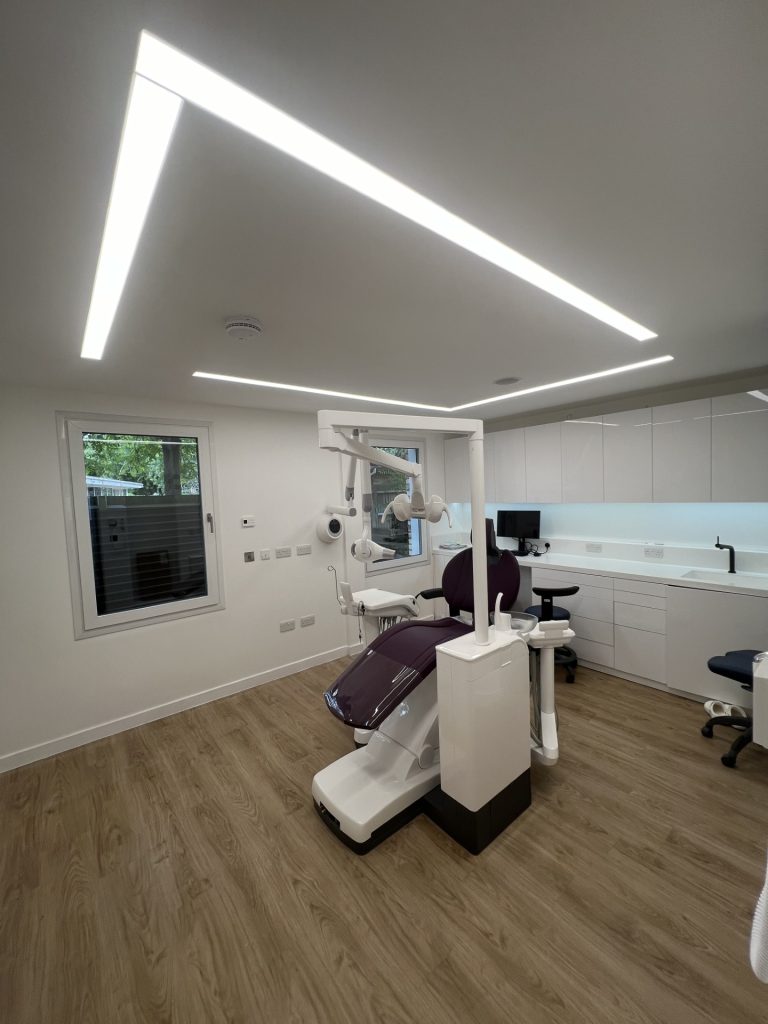
Living in West London, whether near Hammersmith station, Fulham Broadway, or along the Thames riverfront, means juggling busy family, work, and school schedules. However, prioritising preventative family dental care locally ensures that maintaining healthy habits fits smoothly into your routine.
Accessible, High-Quality Family Care
For families in Hammersmith & Fulham, establishing regular care at Alma Smiles offers clear advantages:
At Alma Smiles, we believe that every child in Hammersmith & Fulham deserves a healthy, confident smile. Our modern practice focuses on friendly, evidence-based care tailored to the unique needs of growing families.
Q1: What is the best age for a child to get fissure sealants?
A: Fissure sealants should ideally be applied as soon as the first permanent adult molars erupt, usually around age 6 or 7. A second set of permanent molars emerges around ages 11 to 13, which should also be sealed promptly upon eruption.
Q2: Are fissure sealants safe for young children?
A: Yes. Fissure sealants have been safely used in UK dentistry for decades. They are non-toxic, bio-compatible, and strongly recommended by the NHS, the Oral Health Foundation, and the British Dental Association.
Q3: Does applying fissure sealants or fluoride varnish hurt?
A: Not at all. Both procedures are completely painless and non-invasive. No drilling, cutting, or local anaesthetic injections are required, making them ideal introductory treatments for young or anxious children.
Q4: How long do fissure sealants last on adult teeth?
A: Fissure sealants generally last between 5 and 10 years. Your dentist will inspect their condition during routine 6-month check-ups and can easily top up any areas that show signs of natural wear over time.
Q5: Why is preventative dental care recommended before the August holidays?
A: The summer holidays often bring changes in routine, late bedtimes, and increased consumption of ice creams, sugary treats, and drinks. Applying sealants and fluoride varnish before August creates an immediate protective shield against cavity risks during the break.
Q6: Can adults benefit from fissure sealants as well?
A: While fissure sealants are most commonly applied to children’s newly erupted teeth, adults who have deep tooth fissures without existing fillings or decay can also benefit after a clinical evaluation.
Protecting Your Child’s Health Starts with a Smile
Preventative dental care is the most effective way to protect your child from tooth decay and build strong oral health habits that last a lifetime. By securing their enamel with fissure sealants and fluoride before the summer holidays begin, you can enjoy peace of mind knowing their teeth are protected against seasonal treats and altered routines.
Whether your child is due for their routine check-up, starting to get their first adult molars, or simply needs a pre-holiday review, our caring team at Alma Smiles is here to help.
Take a proactive step for your child’s smile today.
Book Your Appointment Online with Alma Smiles or call our friendly team in Hammersmith & Fulham to arrange your family’s preventative assessment.


What is the Link Between Gum Disease and Heart Health? Quick Navigation: What You Will Learn in This Guide UK Gum Disease Statistics: Key national…
DISCOVER MORE


Invisalign Teen vs Braces: Best Age & Choice | Alma Smiles The teenage years are a formative time defined by self-discovery, academic milestones, and growing…
DISCOVER MORE

Modern Guide to Composite Bonding For many of us, the mere sound of a dental drill can trigger a wave of anxiety. If you have…
DISCOVER MORE

In West London, your wedding day is one of the most photographed milestones of your adult life. Whether you are hosting an elegant reception at…
DISCOVER MORE
Emergency Dentist Hammersmith: Broken Tooth Care | Alma Smiles In West London, a confident, intact smile is a key part of your personal brand. Whether…
DISCOVER MORE

Little Smiles: A Parent’s Guide to Your Child’s First Dental Visit in Hammersmith and Fulham In the heart of West London, we understand that a…
DISCOVER MORE
Teeth Whitening: DIY Kits vs Whitening Gold Standards In West London, a confident smile is part of your personal brand. Whether you are heading to…
DISCOVER MORE

The Lifelong Guide: Dental Care at Every Stage Why Your Smile Needs a Decade-Specific Roadmap In our fast-paced corner of West London, we often plan…
DISCOVER MORE
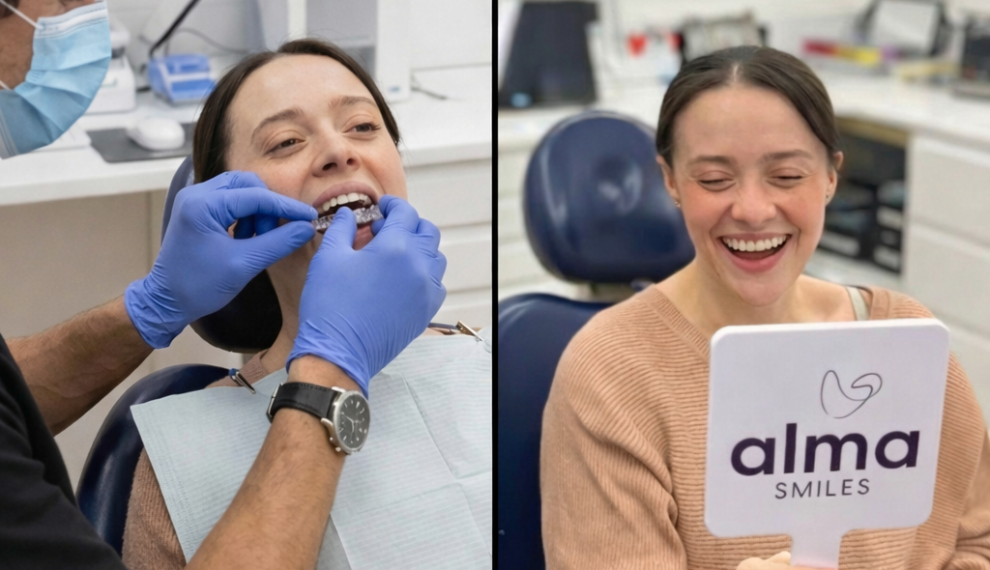
Invisalign in Fulham: Why Professional Care Beats Mail-Order Kits In an era of doorstep deliveries, the appeal of "DIY" dental kits has grown. You’ve…
DISCOVER MORE
Busy in W6 & SW6? Your Friendly Guide to Stress-Free Lunch-Break Dentistry Let’s be honest, life in West London is a whirlwind. Whether you…
DISCOVER MORE
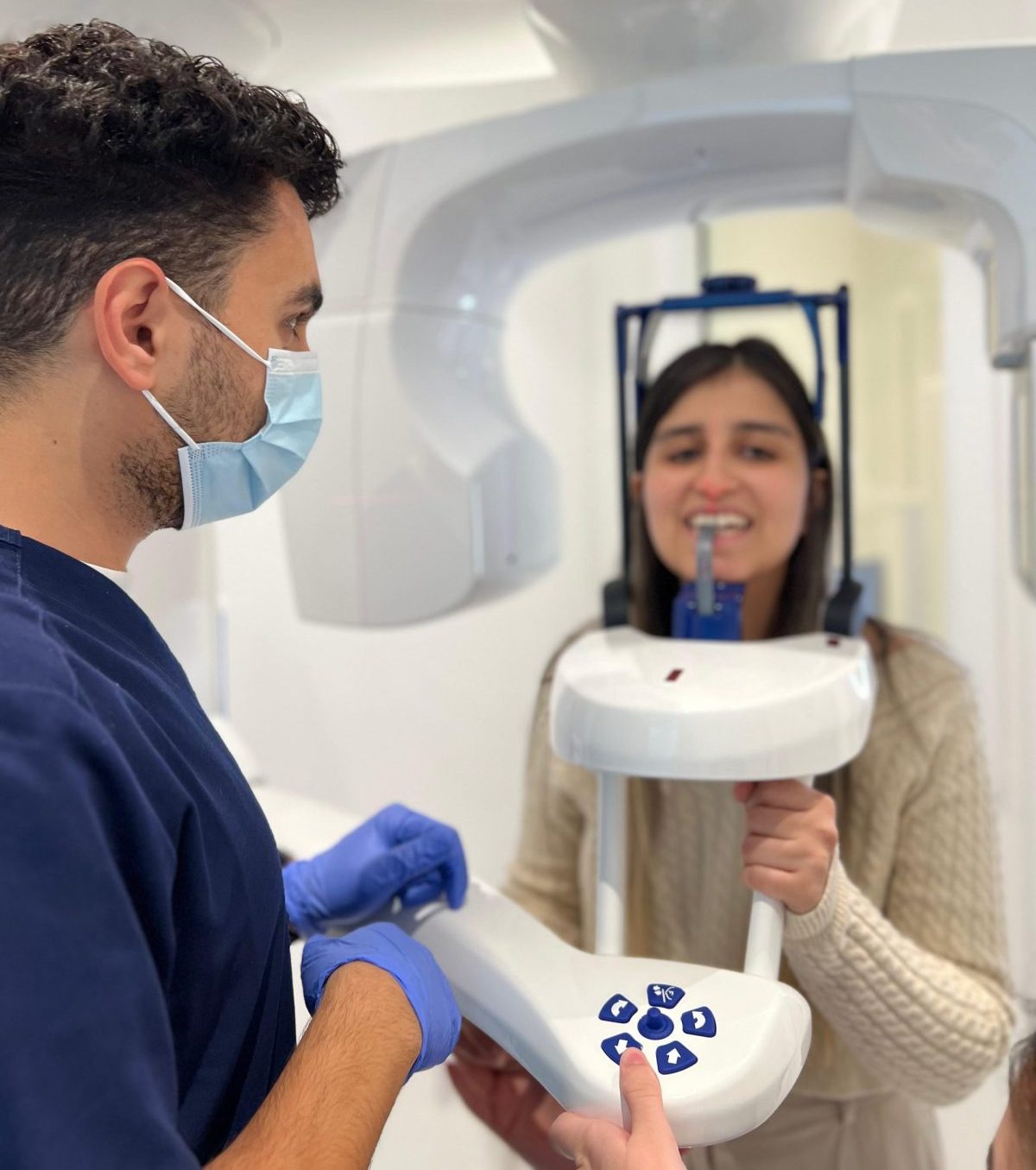
Precision & Transparency In 2026, the gap between public and private dental care has widened due to new NHS contract reforms. While the NHS focuses…
DISCOVER MORE
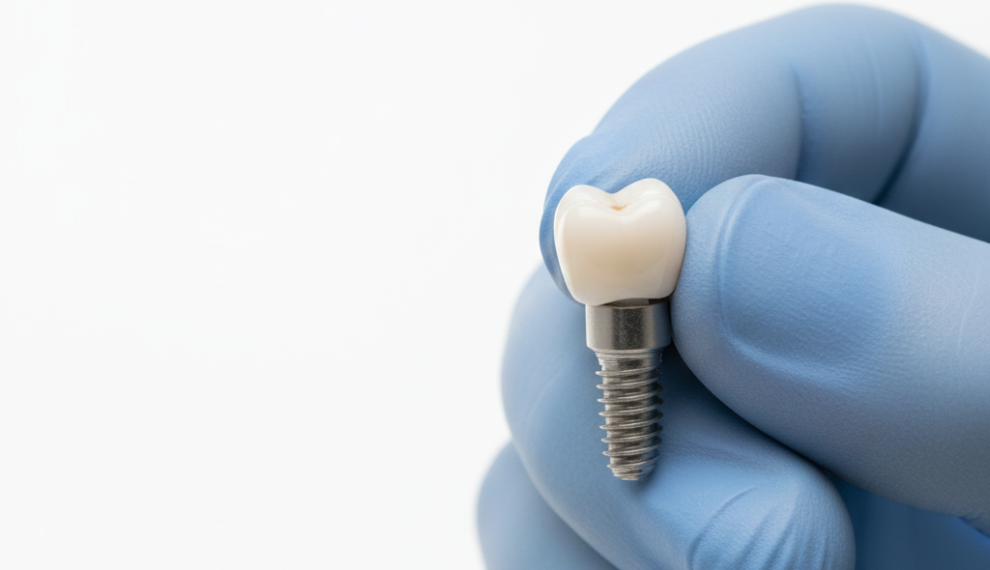
What to Do When Implants Fail? Dental implants are widely regarded as the gold standard for replacing missing teeth. When carefully planned, placed, and maintained,…
DISCOVER MORE
What is the Link Between Gum Disease and Heart Health? Quick Navigation: What You Will Learn in This Guide UK Gum Disease Statistics: Key national…
DISCOVER MORE
Invisalign Teen vs Braces: Best Age & Choice | Alma Smiles The teenage years are a formative time defined by self-discovery, academic milestones, and growing…
DISCOVER MORE
Modern Guide to Composite Bonding For many of us, the mere sound of a dental drill can trigger a wave of anxiety. If you have…
DISCOVER MORE
In West London, your wedding day is one of the most photographed milestones of your adult life. Whether you are hosting an elegant reception at…
DISCOVER MORE
Emergency Dentist Hammersmith: Broken Tooth Care | Alma Smiles In West London, a confident, intact smile is a key part of your personal brand. Whether…
DISCOVER MORE
Little Smiles: A Parent’s Guide to Your Child’s First Dental Visit in Hammersmith and Fulham In the heart of West London, we understand that a…
DISCOVER MORE
Teeth Whitening: DIY Kits vs Whitening Gold Standards In West London, a confident smile is part of your personal brand. Whether you are heading to…
DISCOVER MORE
The Lifelong Guide: Dental Care at Every Stage Why Your Smile Needs a Decade-Specific Roadmap In our fast-paced corner of West London, we often plan…
DISCOVER MORE
Invisalign in Fulham: Why Professional Care Beats Mail-Order Kits In an era of doorstep deliveries, the appeal of "DIY" dental kits has grown. You’ve…
DISCOVER MORE
Busy in W6 & SW6? Your Friendly Guide to Stress-Free Lunch-Break Dentistry Let’s be honest, life in West London is a whirlwind. Whether you…
DISCOVER MORE
Precision & Transparency In 2026, the gap between public and private dental care has widened due to new NHS contract reforms. While the NHS focuses…
DISCOVER MORE
What to Do When Implants Fail? Dental implants are widely regarded as the gold standard for replacing missing teeth. When carefully planned, placed, and maintained,…
DISCOVER MORE

“They have a very nice and friendly staff. The place is modern and clean. I went for a check-up, and the doctor explained everything I…”

“My sincere thanks to Dr Pedro Arteche, who did a wonderful job. When he started working with my teeth, I immediately felt his professionalism. He…”
“Lovely people, and the staff have helped me tremendously. Any questions I have are always answered with great detail, and they're calming and reassuring when…”
“I had a great experience at Alma Smiles with their highly professional staff a very friendly environment. I highly recommend this place. It is clean,…”
“Welcoming staff and pleasant experience. I have been coming to Alma Smiles for years now, and I find it convenient and positive. My teeth have…”
“I would highly recommend Alma Smiles. I had an excellent experience since day one. I have had my orthodontic treatment and am very happy with…”
“I have always found all staff very polite, helpful and very professional. They are very good at giving me the best advice and encouragement and…”
“Great staff, kind and professional. The architecture of the building is very cosy and comfortable. I booked my appointment within minutes, and it took minutes.…”
“Incredible! The best dentist I’ve been to. The staff were so friendly, and the manager was so welcoming and really reassured me when I kept…”
“Doctor Krisztina, Jessie, Alex, Ayah and Joe have all been fantastic, very friendly and patient. While having my root canal, I could not have felt…”
“Alma Smiles - has been my surgery for some time now. I admit I don't like going to the dentist's, but the service provided by…”
“It was an outstanding experience from start to finish! Both my 3-year-old son and I received exceptional care. Pedro and his staff were incredibly patient…”
“I highly recommend Alma Smiles! I had a direct composite and a mouth guard after my tooth canal treatment, and I’m very happy with the…”
“My recent experience at Alma Smiles exceeded my expectations in every way. The staff was friendly and knowledgeable; the facility was modern and clean, and…”
“It is really a top surgery. I even travelled 45 minutes away to get here, even though I had local ones. It's really modern and…”
“They have a very nice and friendly staff. The place is modern and clean. I went for a check-up, and the doctor explained everything I…”
“My sincere thanks to Dr Pedro Arteche, who did a wonderful job. When he started working with my teeth, I immediately felt his professionalism. He…”
“Lovely people, and the staff have helped me tremendously. Any questions I have are always answered with great detail, and they're calming and reassuring when…”
“I had a great experience at Alma Smiles with their highly professional staff a very friendly environment. I highly recommend this place. It is clean,…”
“Welcoming staff and pleasant experience. I have been coming to Alma Smiles for years now, and I find it convenient and positive. My teeth have…”
“I would highly recommend Alma Smiles. I had an excellent experience since day one. I have had my orthodontic treatment and am very happy with…”
“I have always found all staff very polite, helpful and very professional. They are very good at giving me the best advice and encouragement and…”
“Great staff, kind and professional. The architecture of the building is very cosy and comfortable. I booked my appointment within minutes, and it took minutes.…”
“Incredible! The best dentist I’ve been to. The staff were so friendly, and the manager was so welcoming and really reassured me when I kept…”
“Doctor Krisztina, Jessie, Alex, Ayah and Joe have all been fantastic, very friendly and patient. While having my root canal, I could not have felt…”
“Alma Smiles - has been my surgery for some time now. I admit I don't like going to the dentist's, but the service provided by…”
“It was an outstanding experience from start to finish! Both my 3-year-old son and I received exceptional care. Pedro and his staff were incredibly patient…”
“I highly recommend Alma Smiles! I had a direct composite and a mouth guard after my tooth canal treatment, and I’m very happy with the…”
“My recent experience at Alma Smiles exceeded my expectations in every way. The staff was friendly and knowledgeable; the facility was modern and clean, and…”
“It is really a top surgery. I even travelled 45 minutes away to get here, even though I had local ones. It's really modern and…”